English| EUR
Suggested for you
More currencies
Choose a language
The Aegean crossing between Santorini and Mykonos ranks among the most traveled ferry routes in the Cyclades, connecting the caldera's clifftop villages with the whitewashed alleys of Little Venice. Multiple operators run daily departures year-round, with schedules shifting by season and sea conditions. This guide covers operator choices, departure logistics from Athinios Port, and the planning details that make the crossing smooth.
Quick answer
Daily ferry services connect Santorini to Mykonos year-round, with conventional ferries departing Athinios Port between early morning and evening hours. High-speed catamarans complete the crossing in approximately 2.5 hours, while standard vessels take 3.5 to 4.5 hours depending on route and intermediate stops. Ticket prices vary by operator, vessel type, and cabin class, with advance booking recommended during the April-to-October peak season when demand exceeds capacity on popular departure slots.
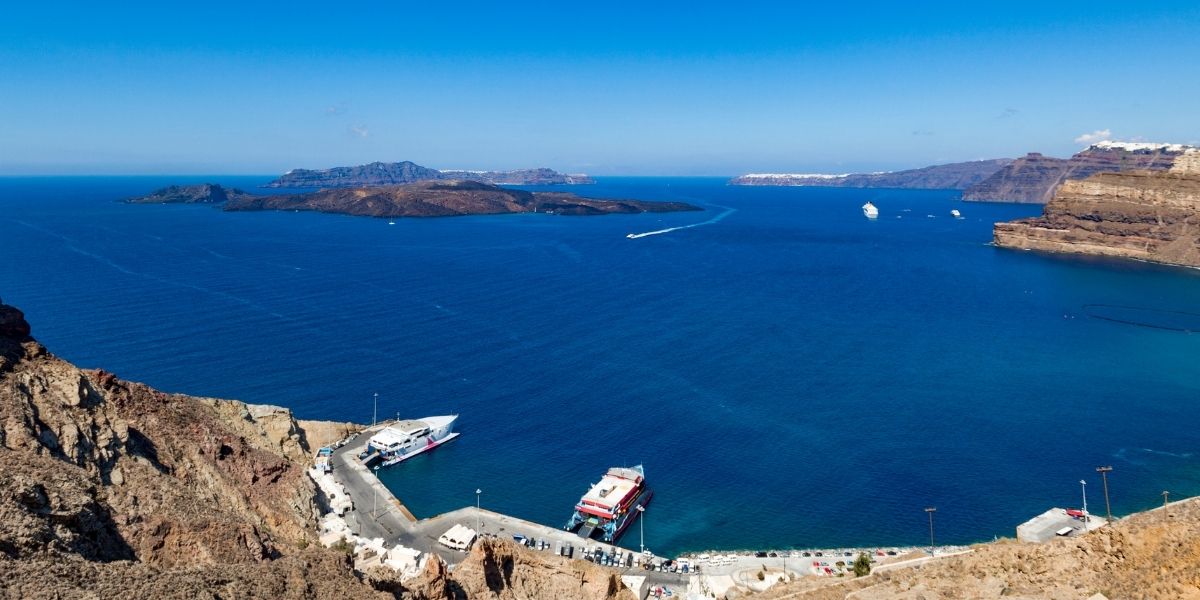
The maritime corridor linking Santorini and Mykonos sees more than half a million passengers annually, yet the crossing remains subject to the Aegean's unpredictable weather patterns—meltemi winds in summer can delay or cancel departures with minimal advance notice. Ferries depart exclusively from Athinios Port, the island's primary commercial harbor carved into the caldera's southern flank, nine kilometers below Fira town. No passenger service operates from the old port beneath Fira or the cruise-ship anchorage at Skala. Operator choice splits into two categories: conventional car ferries offering outdoor deck seating and interior lounges, and high-speed catamarans with assigned aircraft-style seating. The slower vessels stop at Ios, Naxos, or Paros depending on route, extending travel time but offering flexible deck access and lower fares. Fast ferries run direct or with a single intermediate call, trading route flexibility for speed. Both vessel types accommodate foot passengers, vehicles, and freight, though onboard amenities vary—conventional ferries provide cafeterias and open-air viewing areas, while catamarans restrict movement to enclosed cabins with limited visibility. Schedules fluctuate by season, with winter service reduced to one or two daily departures and summer months offering four to six options across morning and afternoon slots. The boat trip from Santorini to Mykonos operates daily throughout the year, but October-through-March schedules condense around midday windows to avoid early-morning and late-evening sea conditions. Tickets release approximately three months in advance, with dynamic pricing that escalates as departure dates approach and cabin availability tightens. Walk-up purchases remain possible during low season, but summer weekends and holiday periods routinely sell out days ahead, particularly for morning departures that allow same-day Mykonos exploration. Port access requires advance planning—Athinios sits at sea level with no pedestrian path from the caldera rim, necessitating bus, taxi, or pre-arranged transfer from accommodation. The terminal itself offers minimal shelter, basic seating, and a single snack kiosk, with boarding beginning 30 to 45 minutes before departure as passengers queue by ticket class and operator.
“The Aegean crossing remains subject to weather patterns that can alter schedules with minimal notice, making flexible booking essential during meltemi season.”
All ferries for the boat trip from Santorini to Mykonos depart from Athinios Port, located in the caldera below Fira. Travelers can reach the port via the main road network connecting the island's primary settlements.
KTEL public bus from Fira central station to Athinios Port
Private transfer via Epar.Od. Firon-Ormou Perissis
Drive via Epar.Od. Firon-Ormou Perissis to Athinios Port
Plan to arrive at Athinios Port, Athinios, Santorini 847 00, Greece, between 06:00–22:00. This arrival window ensures you avoid the most significant port congestion periods.
This timeline covers a typical day-ferry crossing from Athinios Port to Mykonos, suitable for travelers prioritizing cost and flexibility over speed. Budget 6–8 hours port-to-port, including boarding and disembarkation.
Reach the terminal 60–90 minutes before departure to collect tickets, check luggage if needed, and navigate the tiered parking and boarding queues. Early ferries depart between 07:00 and 08:00.
Conventional ferries board 30 minutes prior; high-speed catamarans closer to departure. Stake out outdoor deck space early or settle into assigned indoor cabins, depending on your ticket class.
Standard ferries take 2.5–3 hours; high-speed services cut this to under 2 hours. Use the time to rest, work through onboard cafeterias, or watch the Cycladic islands drift past from the stern deck.
New Port (Tourlos) handles most traffic; Old Port serves smaller craft. Follow foot-passenger signs, claim checked bags, and exit toward the taxi rank or pre-booked shuttle—Mykonos town lies 3 km north of New Port.
The period from May through June and September through October offers the most favorable balance of calm sea conditions and manageable visitor volume. Planning your trip within the 06:00–22:00 arrival window is essential to navigate the port efficiently.
Mild, 20°C–25°C. Lower winds provide smoother ferry crossings.
These months precede the peak summer heat and high-volume tourist surge.
Warm, 21°C–26°C. Sea remains warm after summer.
Crowds begin to thin, and sea conditions are generally stable for travel.
—
Departing early during the week helps avoid the heaviest terminal congestion at Athinios Port.
Verdict: The best time for a boat trip is during the shoulder months of May or September, specifically targeting weekday departures between 06:00 and 22:00.
The port terminal area at Athinios Port operates daily to accommodate ferry departures and arrivals between Santorini and Mykonos.
Access to the port terminal area in Santorini is free of charge. Actual travel costs depend on the ferry operator and ticket class selected for your journey to Mykonos.
Verdict: Travelers pay for ferry tickets based on the specific operator and vessel class chosen for the trip.
Preparation ensures smooth travel between the islands and avoids last-minute complications at the port.
Everything you need to know about boat trip from santorini to mykonos
You can reserve your passage through various ferry operator platforms online or via authorized local travel agencies. Once you have selected your preferred sailing, you can proceed to secure your space through the available booking widget on this page.
Travel times generally range from two to three hours depending on the specific vessel and weather conditions in the Aegean Sea. High-speed catamarans are typically faster than conventional ferries, though schedules may fluctuate based on seasonal demand.
Yes, multiple operators provide regular ferry services connecting the two islands throughout the peak tourist season. You should verify the current seasonal timetable as frequencies can decrease during the autumn months.
Ferry ticket costs vary by operator and the time of booking rather than a fixed entry price. While there is a 0 EUR fee for accessing the port terminal area, you must purchase a separate ticket for your vessel.
To avoid the intense port congestion during peak ferry arrival and departure times, we recommend arriving at the terminal well in advance. Following our suggested arrival window of 06:00 to 22:00 helps ensure a smoother boarding process.
Families are welcome on most inter-island maritime routes, and many vessels offer dedicated seating and amenities for passengers of all ages. Be sure to check the specific baggage and child fare policies of your selected ferry operator when booking.
All ferry departures for this route take place at Athinios Port, which is the primary harbor located within the Santorini Caldera area. This facility handles the majority of the island's commercial ferry traffic.